
You have £900 in savings. The Lowell letter says £2,000. You have read it so many times you could recite it, and the question going round your head is whether offering less will help or make things worse.
What to know first: Offering less is a normal thing to do, and Lowell is expected to look at a reasonable offer properly. In one Financial Ombudsman decision it was told it is “obliged to consider seriously any reasonable offer”. What it will actually accept is not published, so you only find out by asking. Pay nothing until Lowell has accepted in writing, and check the debt is not statute barred first, because paying can restart the clock.
The settlement and time-limit points below are for England and Wales. Scotland and Northern Ireland differ in places, so ask StepChange or Citizens Advice if you live there.
Start with arithmetic, not the letter
Your £900 means nothing to Lowell on its own. What matters is the share of the balance it covers. Against £2,000 it is 45%. Against £4,000 the same £900 is 22.5%, and that is a much harder offer to defend.
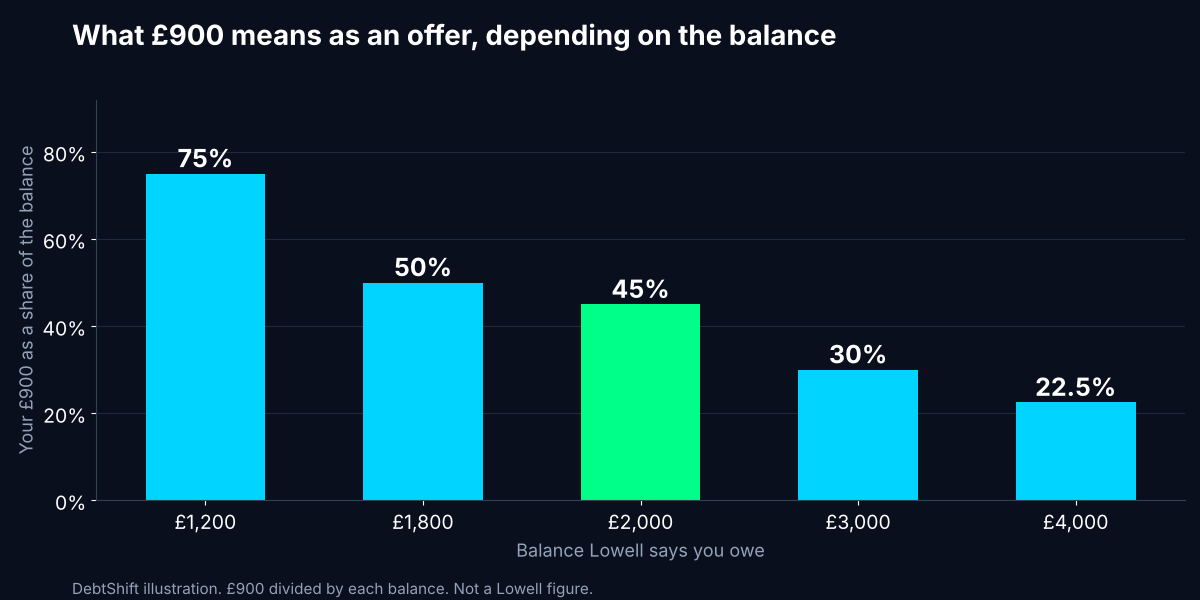
Debt buyers usually pay less than the full amount for a debt, so a settlement can still leave them with a profit. Nobody outside Lowell knows what it paid for yours or what it will take, and there is no published scale. Read the chart as arithmetic, not a forecast.
Two rules about where the money comes from. Use cash that is genuinely spare, not next month’s rent. And do not borrow to settle a debt that has already defaulted, because all you would do is move it to a lender you have not yet missed a payment with.
Priority bills go first
National Debtline puts priority debts ahead of this: rent or mortgage arrears, council tax, and gas and electricity arrears. If one of those is behind, that is where the savings should go before a Lowell discount.
There is a second trap that most settlement guides skip. If you end up in a DRO, IVA or bankruptcy later, paying one creditor and not the others can be treated as a preferential payment, which can cause problems. If a formal solution is even a possibility, run the bankruptcy and DRO checker before you pay anyone.
If you owe more than one creditor
Splitting the money by size is fairer than paying whoever shouts loudest, and it is easier to defend. National Debtline’s formula is your lump sum times each debt, divided by the total you owe. Here is the same sum on made-up figures:
| Creditor | Owed | Your offer |
|---|---|---|
| Lowell | £2,000 | £450 |
| Catalogue account | £500 | £112.50 |
| Overdraft | £1,500 | £337.50 |
| Total | £4,000 | £900 |
Send each creditor the table so they can see you treated everyone alike.
Two people who took Lowell settlements to the Ombudsman
Settlement stories online are mostly someone saying Lowell took 40%. That proves nothing about your case. Decisions published by the Financial Ombudsman Service are different, because they show the facts and the reasoning.
A father’s £1,700 offer
A man’s father offered Lowell £1,700 in full and final settlement. Lowell had already offered a 50% discount, which left £2,014.75, and it refused the lower figure. The Ombudsman found he had been in financial difficulty for around five years with nothing to suggest it would change, and that the offer was reasonable, since his father had already raised it once. It told Lowell to write off £2,349.51 of the debt (decision, around 2019).
The three-instalment deal that was not a write-off
Miss B agreed on 8 August 2019 to settle a £2,502.86 balance for £250.29, paid over three months. Later she was owed a £2,096.61 refund on the original account, for a mis-sold payment protection policy (PPI). Lowell used it to reduce the debt instead of paying it to her. The Ombudsman did not uphold her complaint: the deal had never written the debt off. Lowell had only agreed not to chase the full balance while she kept to the plan, so the debt still existed and the refund could be set against it (decision).
What both show is that a reasonable offer gets looked at on its merits, and that the exact words of the agreement decide everything. Each is one person’s case, so neither sets a price for yours.
The sentence that decides whether it is really over
After reading Miss B’s case, one line matters more than the amount you offer. You need written confirmation that your payment settles the debt in full, that nothing more is owed, and that no balance will be passed on or sold. This is a letter you can adapt:
Account reference: [number]. Balance you state: £[amount].
I am offering £[amount], as a single payment, in full and final settlement of this account. If you accept, please confirm in writing that:
1. the payment settles the debt in full and nothing further is owed;
2. you will not pursue, sell or transfer any remaining balance;
3. you will update my credit file to show the account as settled, closed and with a zero balance.
I will not send any payment until I have your written acceptance.
Yours sincerely,
[name and address]
Send it in a way you can prove, and keep every reply. National Debtline’s advice is never to send a lump sum before the offer is accepted. Once the money has gone it cannot be un-sent. If Lowell phones with a deal, ask it to put the terms in writing first.
If you want to pay in instalments, the Miss B case is the warning. Ask for the letter to say the debt is written off once the last payment clears.
If Lowell says no, write again and ask it to reconsider, as National Debtline suggests. If it will not engage with an offer that is reasonable for your situation, you can complain to Lowell and then to the Financial Ombudsman Service. Not sure the letter is genuine? Check it with our guide to Lowell letters and texts first.
Check the date before you pay anything
In England and Wales, the usual time limit for taking a credit card or loan debt to court is six years, as long as nothing has restarted it. National Debtline says a payment or a written acknowledgement of the debt might restart that clock. So if your debt is old, a well-meant £900 could throw away protection you already had. Run it through the statute barred checker before you answer anything.
What your credit file will say afterwards
A default stays on your file for six years from the date it was recorded, even if you pay it off (Experian). Settling does not shorten that. What changes is how it reads. A paid default is marked as satisfied, which Experian says looks better to lenders, and National Debtline warns you may also see a “P flag”, short for partial settlement. Ask Lowell to confirm in writing how it will report the account, then check your file with the credit reference agencies a month or two later.
Before you press send
Is £900 enough?
There is no fixed percentage to aim for. £900 against £2,000 is 45%, and the figure that matters most is whether the offer is reasonable for what you can really afford. In the Ombudsman case above, it counted that the person had been struggling for years with no sign of improvement.
Will Lowell just say no?
It might. National Debtline suggests writing again, asking it to reconsider and explaining your circumstances once more. A first refusal is not the end of it.
Can a relative pay it for me?
Yes. National Debtline says money from a friend or relative’s own pocket is not normally treated as a preferential payment, and it suggests telling the creditor the money is only available if the offer is accepted.
Will this help me get a mortgage?
Lenders differ, and a settled default is still a default for six years from the date it was recorded. Ask a mortgage broker before you decide, rather than assuming.
What if I cannot raise even £900?
Call StepChange free on 0800 138 1111 before you pay anyone. A debt relief order or other formal route may fit better than a settlement, and the bankruptcy and DRO checker gives you a quick first read.
If the debt itself is the problem and not just the balance, read what happens if you ignore Lowell and what to do when your debt is sold to Lowell. For the other routes, see how to write off debt in the UK.
Disclaimer: DebtShift is an educational platform operated by H Ali Logistics Ltd, which is not authorised or regulated by the Financial Conduct Authority (FCA). This article is general education, not financial or legal advice. For free, impartial debt advice, contact StepChange on 0800 138 1111.
Sources
- National Debtline, Full and final settlement offers (England and Wales)
- National Debtline, Statute barred debts (England and Wales)
- Experian, Dealing with defaults on your credit report
- Financial Ombudsman Service decision DRN3824914
- Financial Ombudsman Service decision DRN-1639293
Last reviewed November 2026
Free and occasional
Get plain-English debt help in your inbox
A few emails a month at most: practical debt tips and a heads-up when we launch a new free tool. No spam. Unsubscribe in one click.